For my second assignment I have to record a 5 minute video presentation. These are the notes used in the recording.
Introduction.
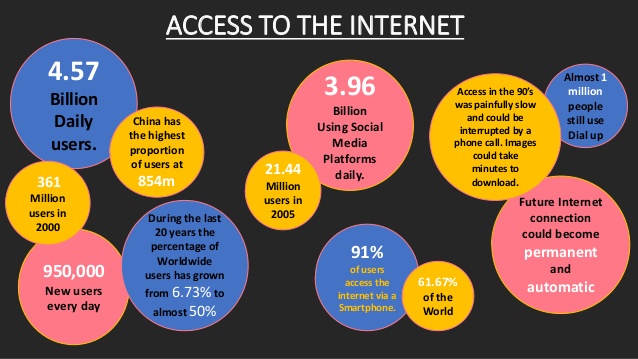
In 2000 361 million people accessed the internet each day. 7% of the population.
Fast forward 20 years to 2020 and that has grown to 4.57 billion daily users, almost half the World’s population.
The UK sits high up in the amount of hours we spend online each day. Much is on Social Media platforms. Almost 4 billion people access social media accounts each day.
Smartphones have become a permanent fixture, with 90% of internet access being via smartphones.
When we make the choice to go online via our phone, laptop, PC or tablet we are looking to fulfil one of 4 needs; Exploration, Connection, Self-expression or Convenience.
Exploration and Convenience. Search for info.
Many of us have become reliant on the internet, particularly when seeking information.
Example of finding a local yoga class; In the past it would take some effort, now we can use a search engine and a few key words to find out what we need.
We can then look on Websites, social media pages, review sites etc to find out more information. We can potentially view videos to find out what to expect, explore routes on Google maps and book online. We can do this at any time of the day or night.
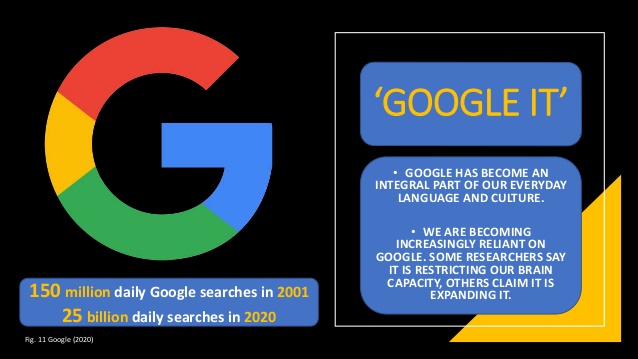
The term ‘Google it’ has become an integral part of our everyday language and culture. The search engine answers 25 billion searches each day.
Some researchers claim it is impeding our brain capacity and decision making ability, whereas others say it is expanding it.
Shopping.
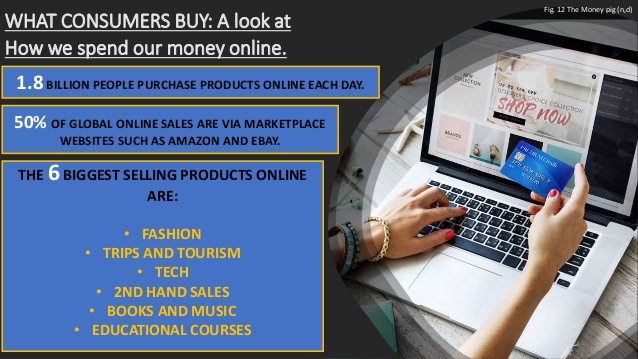
1.8 billion people make an online purchase each day. 50% via marketplace sites.
Top selling products are; Fashion, tourism, tech, books, music and second hand sales.
Social media has a huge part to play with influencers able to earn large sums of money by promoting goods on their pages. This influences what we wear, how we look, where we travel to and our overall aspirations and goals. It is becoming intrinsic to who we are.
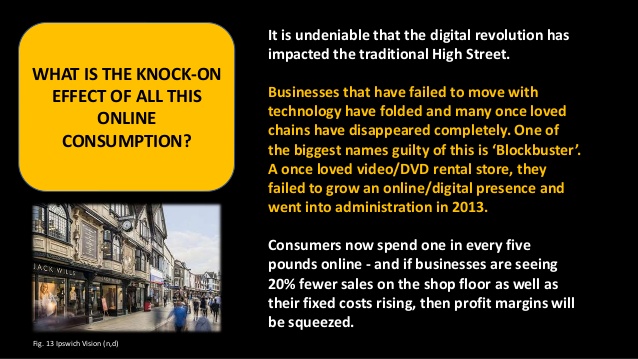
£1 in every £5 is spent online. There has been an impact on the High Street. Businesses that fail to incorporate a digital aspect have been left behind. Ecommerce sites are also now at risk if they fail to develop an easy to use mobile version of their site. Consumers want fast checkout times, otherwise they will shop elsewhere.
Video.
As marketers we must also take note of the role video has to play in the online buying process. 76% of consumers do so after watching a video. Millennials, in particular are influenced by video. 55% of internet users watch videos daily. It forms a key part of any digital marketing plan.
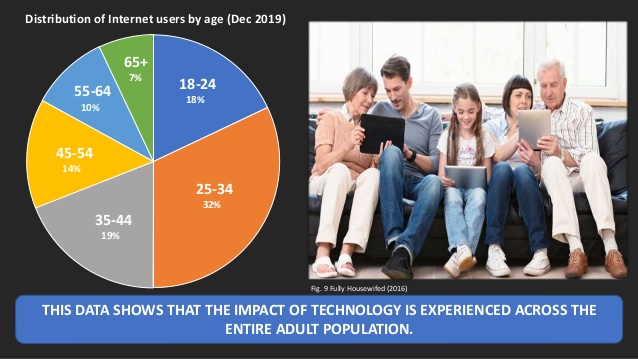
It’s not only the younger generation we must focus our attention on, as half those accessing the internet are over 35.
Trends.
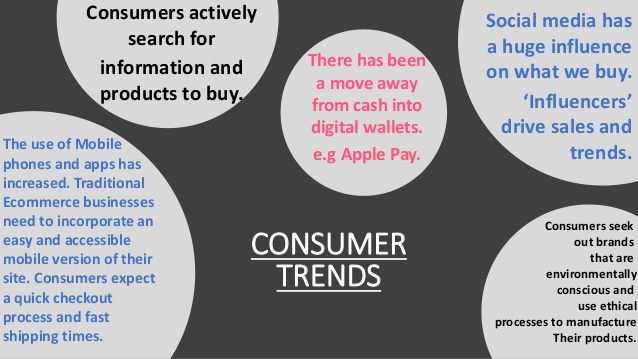
The digital consumer is more informed, more connected and more empowered than ever before. Brands are no longer driving the trends. Consumers today know what they want, they are more active and expect more. They can compare prices at the click of a button, read reviews and choose from a sometimes overwhelming number of companies. The 2020 consumer will seek out brands that use ethical processes and are environmentally conscious. They want quick delivery times and options to use digital wallets as we move away from cash.
Summary.
Our use of technology and the internet since it’s conception has come a huge way. It impacts our lives in many positive and sometimes negative ways, but it is here to stay and as marketers we cannot underestimate it’s role in our everyday lives.
Image References.
Figure 9. Fully Housewifed(2016) Stengtheningfamily ties through technology (photograph)
Figure 11. Google (2020) Google Logo (graphic)
Figure 12. The Money Pig (n,d) The 10 credit card commandments (photograph)
Figure 13. Ipswich Vision (n,d) Boost the town centre with a wide ranging programme of enhancements (photograph)
Text References.
Andrews, E (2019) Who Invented the Internet. (online) available at:
https://www.history.com/news/who-invented-the-internet
Internet World Stats (2010) The incredible growth of the internet since 2000.(online) Available at:
Home – PP
Statistica.com(2020) Most popular global messenger apps as of July 2020. (online) available at:
https://www.statista.com/statistics/258749/most-popular-global-mobile-messenger-apps/
Clement, J (2020) Age distribution of internet users Worldwide (online) available at:
https://www.statista.com/statistics/272365/age-distribution-of-internet-users-worldwide/
Datareportal.com(2020) Digital around the World. (online) available at:
https://datareportal.com/global-digital-overview
Data.worldbank.org(2019) Individuals using the internet (online) available at:
https://data.worldbank.org/indicator/IT.NET.USER.ZS
DeMers, J (2016) 7 predictions for how the internet will change over the next 15 years (online) available at:
Cossick, S (2019) Dial up and our fondness for the first connection (online) available at:
bt.com(2018) From dial up internet to early websites: 19 scenarios from the early days of the internet(online) available at:
Miller, M (n,d) Understanding how people search the web (online) available at:
Home
social4retail.com (2018) How people search the internet 2018 infographic (online) available at:
https://www.social4retail.com/how-people-search-the-internet-2018-infographic.html
Mohsin, M (2020) 10 online shopping statistics you need to know in 2020 (online) available at:
https://www.oberlo.co.uk/blog/online-shopping-statistics
doofinder.com(n,d) What are the 6 best-selling products on the internet? How can you enter those markets? (online) available at:
https://www.doofinder.com/en/blog/best-selling-products-on-the-internet
Simpson, E (2019) High Street: How many UK shops have closed? (online) available at:
https://www.bbc.co.uk/news/business-49349703
lovemoney.com(2019) Well-known brands that have disappeared from UK Hight streets (online) available at:
Link to Slideshare for the full Powerpoint presentation:
https://www.slideshare.net/secret/RyIXRmrqvToaP
Link to Vimeo for the full video presentation:
 Curiously Suffolk